Start College Chemistry with CONFIDENCE

Whether you're taking General Chemistry I or II this fall, a strong start can make the difference between struggling to keep up and thriving from day one.
Our live online summer prep courses review the most important concepts students need before the semester begins. We focus on the topics that cause students the most difficulty in the first weeks of chemistry, helping them build confidence and avoid the stress of playing catch-up.
• Small group live instruction with direct student interaction
• Guided practice problems and structured homework support
• Designed for incoming General Chemistry I and II students, including pre-med and STEM majors

Why Take a Summer Prep Course?

Why College Chemistry Is Different

Many students assume that high school chemistry will fully prepare them for college chemistry. Unfortunately, that’s often not the case.

College chemistry moves quickly and expects students to apply concepts at a deeper level than most high school courses. Even students who earned A’s in high school chemistry can find themselves overwhelmed by the pace and expectations of a university course.

Unlike self paced review courses, students learn in a live classroom environment where they can ask questions and receive immediate feedback.

Your instructor, Karin Stevens, has taught college chemistry for more than a decade and has helped hundreds of students successfully navigate General Chemistry.

Students learn how to think through chemistry problems at a college level, not a high school level.
About Me

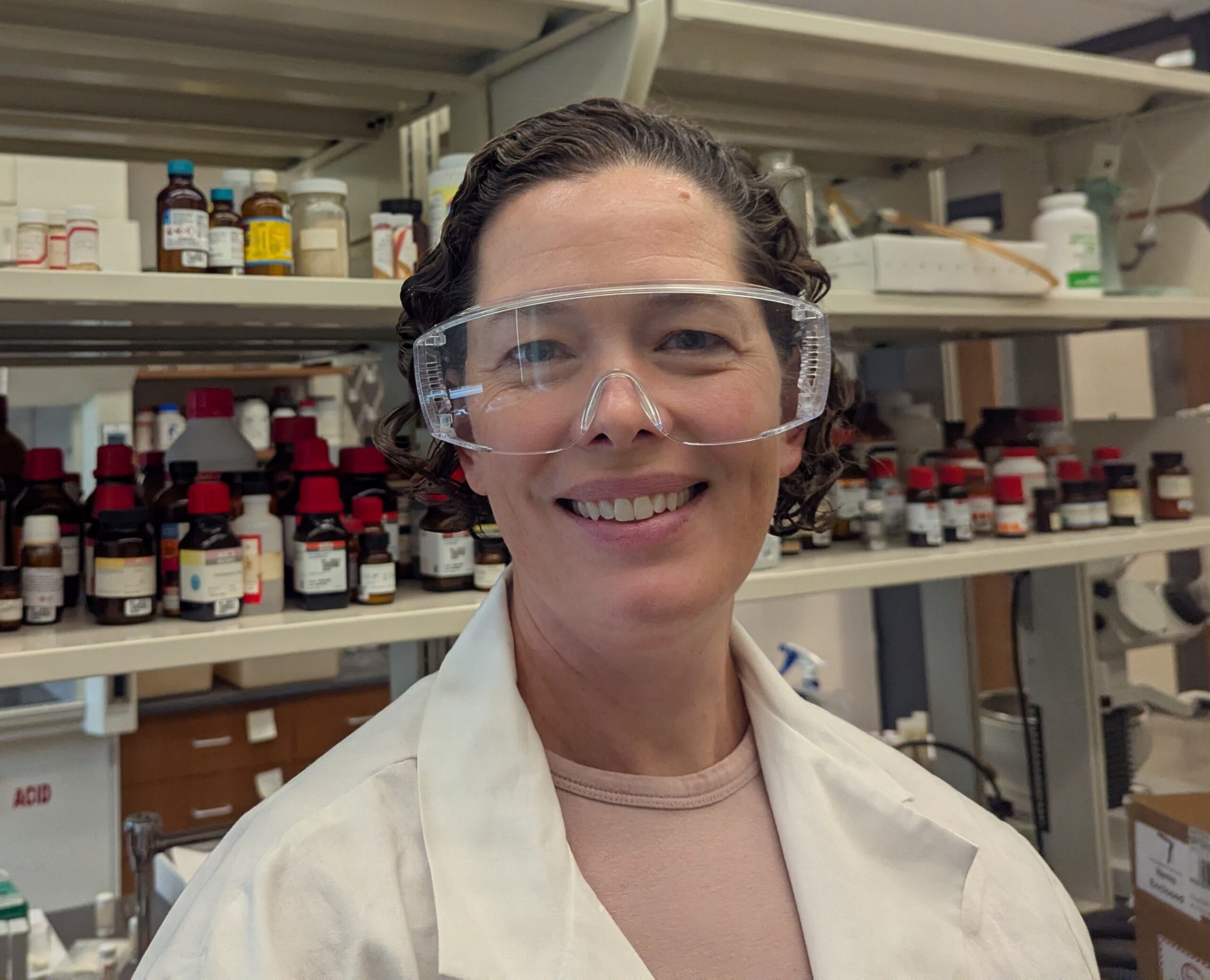
Karin Stevens

I hold a Master’s in Chemistry from University of California, Berkeley and have over a decade of experience teaching chemistry at Davidson College.
My teaching style focuses on breaking complex topics into clear, understandable steps while helping students develop the problem solving skills needed for long term success.
College Level Instruction

Learn from a UC Berkeley trained chemist and former college chemistry professor with over ten years of experience teaching, including organic chemisty.

Develop Problem Solving Skills

Learn a systematic approach to solving chemistry problems so you can tackle new and unfamiliar questions with confidence.

Strong Foundation in Chemistry Fundamentals

Build a deep understanding of the core concepts that form the foundation of college chemistry, including molecular geometry, polarity, intermolecular forces, stoichiometry, thermochemistry, and equilibrium.

Build the Foundations for Success in General Chemistry I

General chemistry is often one of the first challenging STEM courses students encounter in college. These sessions focus on building a strong foundation in key concepts while developing the analytical and quantitative reasoning skills students need to start the semester with confidence.
General Chemistry Prep I Session A: Quantitative Foundations of Chemistry

Learning Outcomes:

  • Convert between moles, mass, and number of particles using Avogadro’s number and molar mass
  • Balance chemical equations to satisfy the law of conservation of mass
  • Use balanced equations to predict the amounts of reactants and products in chemical reactions
  • Identify limiting reactants and determine the maximum amount of product that can be formed
  • Calculate percent yield and evaluate the efficiency of chemical reactions

Learning outcomes:

  • Solve stoichiometry problems involving gases and solutions
  • Predict and analyze precipitation reactions using solubility rules
  • Describe the structure of atoms in terms of protons, neutrons, electrons, and isotopes
  • Interpret quantum numbers and relate them to electron behavior in atoms
  • Write electron configurations and orbital diagrams for atoms and ions
  • Use periodic trends to predict and explain chemical properties such as atomic radius, ionization energy, and electronegativity

Learning Outcomes:

  • Draw accurate Lewis structures for molecules and polyatomic ions
  • Predict molecular geometry using VSEPR theory.
  • Determine whether a molecule is polar or nonpolar based on its structure and bonding
  • Determine whether a molecule is polar or nonpolar based on its structure and bonding
  • Analyze bond dipoles and molecular dipole moments to predict molecular behavior
  • Relate molecular shape and polarity to chemical and physical properties

Learning Outcomes:

  • Determine hybridization and relate hybrid orbitals to molecular geometry
  • Evaluate Lewis structures using formal charge considerations
  • Identify and compare intermolecular forces and predict their effects on physical properties
  • Explain molecular bonding using molecular orbital theory
  • Use bonding models to predict stability, bond order, and magnetic properties of molecules

Build the Foundations for Success in General Chemistry II

General Chemistry II builds on the foundation from General Chemistry I and is often where students encounter some of the most challenging topics in college chemistry. These sessions help reinforce key concepts and develop the skills needed to avoid falling behind and start the semester with confidence.
General Chemistry Prep II Session A: Chemical Kinetics
  • Understand the factors that determine how quickly chemical reactions occur
  • Analyze experimental data to determine reaction rates and derive rate laws
  • Apply integrated rate laws to predict how reaction concentrations change over time
  • Develop a conceptual understanding of reaction mechanisms and how they relate to observed reaction rates
  • Write and calculate equilibrium constants for chemical reactions
  • Predict the direction a reaction will shift using the reaction quotient
  • Solve equilibrium problems using ICE tables with confidence
  • Apply Le Châtelier’s Principle to explain how changes in conditions affect chemical equilibrium
  • Analyze solubility equilibria and predict the effects of the common ion effect on solution chemistry
  • Explain how energy is transferred during physical and chemical changes
  • Calculate enthalpy changes using heats of formation, Hess’s Law, and bond energies
  • Interpret heating curves and phase changes to understand how matter responds to energy
  • Solve calorimetry problems involving heat transfer and temperature changes
  • Distinguish between the major theories of acids and bases and apply them to chemical reactions
  • Calculate pH and pOH for strong and weak acid and base solutions
  • Analyze the behavior of weak acids, weak bases, and polyprotic acids in solution
  • Identify conjugate acid-base pairs and predict their behavior in equilibrium
  • Solve buffer and titration problems using a logical, step-by-step approach

Expert Led Preparation for General Cemistry I

Small-group learning to prepare students for excellence in General Chemistry I
Early enrollment ensures placement before classes fill.

Available Classes

General Chemistry I Prep: Session A

3 hours of live, professor led instruction

Starts August 10th

General Chemistry I Prep: Session B

3 hours of live, professor led instruction

Starts August 12th

General Chemistry I Prep: Session C

3 hours of live, professor led instruction

Starts August 17th

General Chemistry I Prep: Session D

3 hours of live, professor led instruction

Starts August 19th

Have questions?
Speak with Karin directly to discuss goals, preparation and course fit.

Expert Led Preparation for General Chemistry II

Small-group learning to prepare students for excellence in General Chemistry II
Early enrollment ensures placement before classes fill.

Available Classes

General Chemistry I Prep: Session A

3 hours of live, professor led instruction

Starts August 10th

General Chemistry I Prep: Session B

3 hours of live, professor led instruction

Starts August 12th

General Chemistry I Prep: Session C

3 hours of live, professor led instruction

Starts August 17th

General Chemistry I Prep: Session D

3 hours of live, professor led instruction

Starts August 19th

Have questions?
Speak with Karin directly to discuss goals, preparation and course fit.

Have questions about the class?

set up a FREE consultation or Download your FREE guides below!
By enrolling you agree to all terms and conditions. A copy of this document will be available for personal reference once registration is complete.

General Chemistry I Prep
Single Session Registration

Enrollment is limited to maintain small group instruction.

3 hours of instruction | Tuition $224

Secure checkout | Limited enrollment | Live instruction

General Chemistry I Prep
4 Session Registration

Enrollment is limited to maintain small group instruction.

12 hours of instruction | Tuition $799

Secure checkout | Limited enrollment | Live instruction

Zelle or Venmo Prep Course Registration

Enrollment is limited to maintain small group instruction.


Secure checkout | Limited enrollment | Live instruction

General Chemistry II Prep
Single Session Registration

Enrollment is limited to maintain small group instruction.

3 hours of instruction | Tuition $224

Secure checkout | Limited enrollment | Live instruction

General Chemistry I Prep
4 Session Registration

Enrollment is limited to maintain small group instruction.

12 hours of instruction | Tuition $799

Secure checkout | Limited enrollment | Live instruction

Zelle or Venmo Prep Course Registration

Enrollment is limited to maintain small group instruction.


Secure checkout | Limited enrollment | Live instruction

Schedule a FREE consultation.

  • Ask any questions you have about summer prep, course structure, or study materials
  • Preview the full range of course resources, including, extra problems, study guides, and walkthroughs
  • Determine if our small-group General Chemistry Summer Prep is the right fit for your student

You can also email me directly at Karin@ChemHelpASAP.com

Frequently Asked Questions

Do I have to start with Session A?

You can start with any session as long as you’re comfortable with the topics in the earlier ones. Keep in mind that each session will build upon the concepts of the earlier sessions. If you are unsure about a topic, I would not recommend skipping ahead.

Each session includes supplemental video lessons, and homework sets. While all assignments are optional, each comes with answer keys to help you check your understanding.
I strongly encourage students to complete the practice problems; they’re one of the best ways to reinforce and retain what you’ve learned.

Each session meets for two days for 90 minute live sessions. 

Please note that all times shown in the schedule are EASTERN time.

If a student misses a session, they’ll receive a summary of the material covered and be directed to the relevant video content for review. While make-up sessions are not offered, I’m always available by email to answer questions and provide support.

These courses are live instructional courses. Classes meet at a specific time and day. Please make sure of the schedule before registering!